
Tomonari Tanaka
Professor, Department of Biobased Materials Science, Kyoto Institute of Technology
He graduated from the Department of Biomolecular Engineering, Graduate School of Engineering, Tohoku University in 2009 and received his Ph.D. degree from Tohoku University under the supervision of Professor Shin-ichiro Shoda. He spent his postdoctoral period at Tohoku University as a JSPS Research Fellow. In 2010, he moved to the Department of Biobased Materials Science, Graduate School of Science and Technology, Kyoto Institute of Technology, as an Assistant Professor. Additionally, from 2015 to 2016, he joined Professor Benjamin G. Davis’s group in the Department of Chemistry, University of Oxford, as an academic visitor. After being promoted to Associate Professor at Kyoto Institute of Technology in 2018, he was promoted to Professor in 2024. His research interests include glycotechnology, polymer chemistry, and synthetic chemistry.
Glycopolymers are functional polymers that strongly interact with carbohydrate-binding proteins owing to the cluster glycoside effect, which arises from the high-density arrangement of saccharide moieties along their side chains. Traditionally, most glycopolymers have been synthesized in organic solvents. However, increasing attention has recently been directed toward aqueous synthesis because of safety considerations and the need to reduce environmental impact. This review provides an overview of representative methods for glycopolymer synthesis and introduces post-polymerization modifications using water-soluble activated esters, as well as one-pot syntheses of glycopolymers from unprotected sugars via chemoenzymatic methods in water. These approaches demonstrate new possibilities for the sustainable synthesis of glycopolymers in water.
Water is an excellent solvent for carbohydrates. Many carbohydrates, including monosaccharides, disaccharides, oligosaccharides, and polysaccharides with a few exceptions, as well as their conjugates, are soluble in water. In chemical synthesis, however, water is often considered an interfering factor. A typical example is glycosylation, for which strictly anhydrous conditions are required to form glycosidic linkages between saccharides1-3.
In recent years, efforts to establish a sustainable society have accelerated, making it urgent to reduce dependence on fossil resources such as petroleum. The fifth of the twelve principles of green chemistry, proposed at the end of the 20th century, emphasizes the use of safe solvents4. Water is significantly safer than most organic solvents; however, its physical properties—such as a higher boiling point, greater polarity, and higher viscosity compared to commonly used organic solvents—can present disadvantages. Nevertheless, carbohydrates are intrinsically associated with water, and considering their properties, handling them in aqueous systems is important.
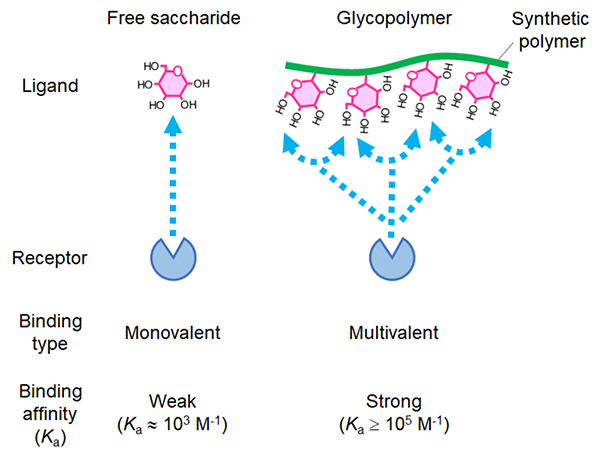
Glycopolymers are functional polymers based on carbohydrates, consisting of a synthetic polymer backbone with numerous saccharide moieties attached to the side chains5,6. These polymers are characterized by the high-density arrangement of saccharide moieties along the polymer chain, which enables strong binding to carbohydrate-binding proteins such as lectins. This phenomenon is known as the “cluster glycoside effect” or the “multivalent effect” (Figure 1)7,8. This review provides an overview of representative synthetic methods for glycopolymers and introduces our recently developed approaches for synthesizing glycopolymers in water.
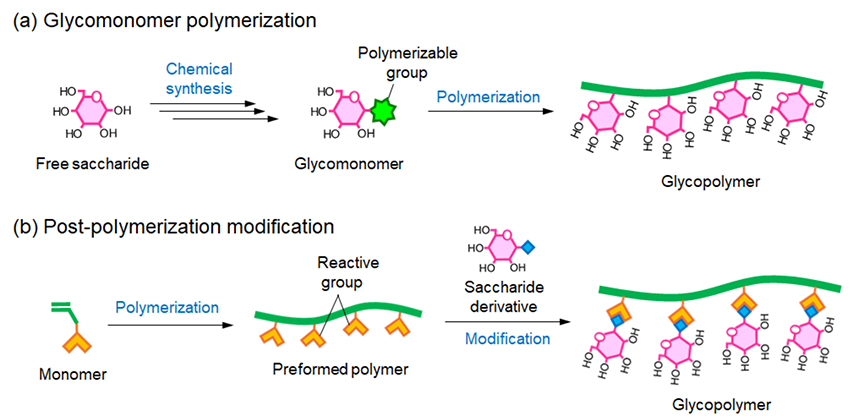
The synthesis of glycopolymers can be broadly classified into two approaches: the polymerization of glycomonomers (the glycomonomer polymerization method) and the modification of saccharide derivatives onto the side chains of preformed polymers (the post-polymerization modification method) (Figure 2)9,10. In most cases, both methods are conducted in organic solvents. In the glycomonomer polymerization method, glycomonomers bearing a polymerizable functional group, such as a vinyl group, are synthesized from free saccharides. This process typically involves multistep reactions, including the protection and deprotection of the saccharide hydroxy groups. The resulting glycomonomers are then polymerized to obtain glycopolymers. In some cases, deprotected glycomonomers are polymerized directly; in others, protected glycomonomers are first polymerized to form glycopolymers, followed by deprotection of the saccharide moieties.
The post-polymerization modification method is a widely used strategy for synthesizing functional polymers. It involves introducing desired derivatives onto preformed polymers that bear reactive functional groups on their side chains and has been extensively applied to glycopolymer synthesis11-13. Click chemistry approaches, such as azide–alkyne cycloaddition and thiol–ene reactions14,15, as well as amidation reactions between activated esters (e.g., N-hydroxysuccinimide (NHS) and pentafluorophenyl (PFP)) and amino-containing compounds16,17, are commonly employed. However, because NHS and PFP esters are hydrophobic, post-polymerization modification using these activated esters is typically performed in organic solvents. When deprotected saccharide derivatives are used, the choice of organic solvents is often limited to aprotic polar solvents, such as dimethyl sulfoxide and N,N-dimethylformamide. In light of the growing demand to reduce environmental impact and reliance on fossil resources, we have focused on the importance of conducting glycopolymer synthesis in aqueous systems under these circumstances.
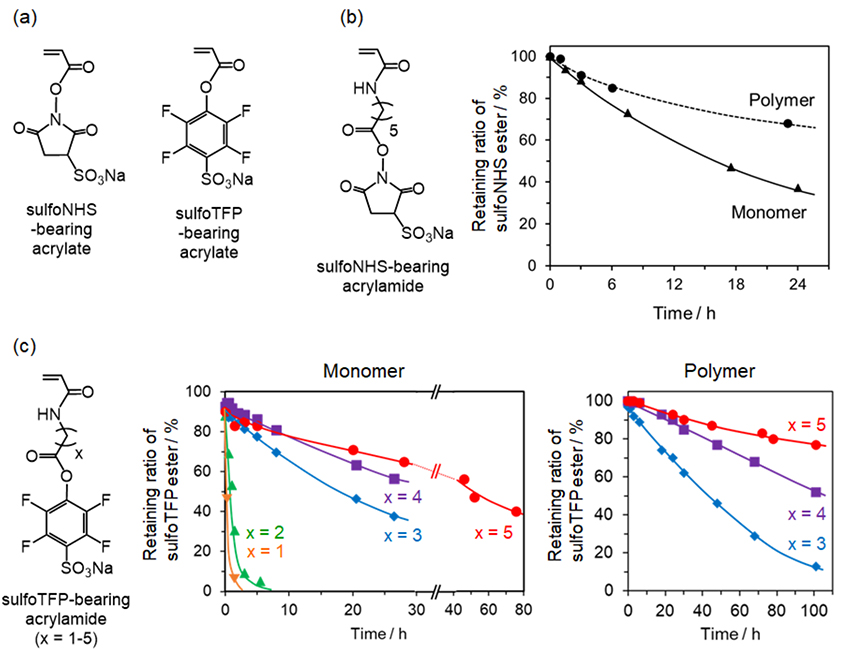
Sulfonated N-hydroxysuccinimide (sulfoNHS) esters and sulfonated tetrafluorophenyl (sulfoTFP) esters are known as water-soluble activated esters18,19. Niu and coworkers reported the polymerization of a sulfoNHS-bearing acrylate monomer (Figure 3a) in water, followed by the synthesis of functional polymers through post-polymerization modification using the resulting sulfoNHS-containing polymer20. However, the sulfoNHS-bearing monomer undergoes hydrolysis in water and is unstable, with a half-life time of approximately 1 h. Therefore, polymerization in water was conducted via rapid photoinduced polymerization, completed within approximately 10 min. Additionally, the resulting sulfoNHS-containing polymers were used directly in subsequent post-polymerization modification reactions without isolation. A sulfoTFP-bearing acrylate monomer has also been reported21.
We developed novel water-soluble activated ester-bearing acrylamide monomers and polymers with improved stability in water. This was achieved by introducing an alkyl chain between the activated ester group (either sulfoNHS or sulfoTFP) and the vinyl group (Figure 3b,c)22,23. These monomers exhibited significantly higher stability in water compared with conventional compounds, with half-lives of 16 h for sulfoNHS and 50 h for sulfoTFP (x = 5; the alkyl chain length shown in Figure 3c). Additionally, the water-soluble activated ester-bearing polymers obtained by radical polymerization of these monomers could be isolated in both the sulfoNHS and sulfoTFP systems. The isolated polymers were more stable in water than the corresponding monomers, showing times required for 20% decomposition of 10 h for sulfoNHS and more than 100 h for sulfoTFP (x = 5). For sulfoTFP, both the monomers and polymers became increasingly stable in water as the alkyl chain length increased. This behavior is attributable to hydrophobic interactions among the alkyl chains, which likely form aggregates that suppress the attack of water molecules on the water-soluble activated ester groups. Zhao and coworkers also reported fluorophenyl ester-bearing polymers containing heptaethylene glycol as water-soluble activated esters that do not decompose in water24. These polymers were applied to amidation reactions via post-polymerization modification in water.
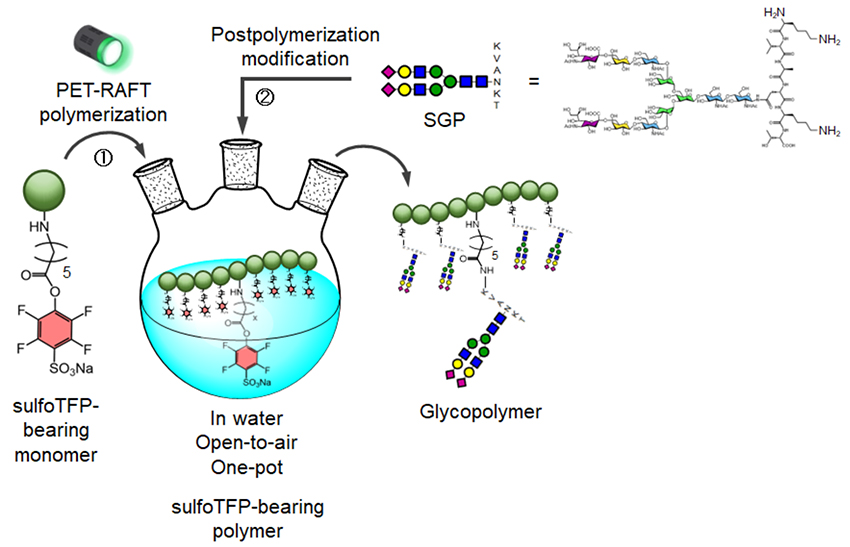
We applied acrylamide-type sulfoNHS- and sulfoTFP-bearing polymers, prepared in water, to post-polymerization modification reactions. We then extended this approach to the synthesis of glycopolymers bearing sialylglycopeptide (SGP), among others23,25. Binding studies using the corresponding lectins and the influenza virus hemagglutinin confirmed strong saccharide–protein interactions for the resulting glycopolymers, attributable to the cluster glycoside effect. Additionally, we reported a one-pot synthesis of glycopolymers in water via water-soluble activated ester-bearing polymers through photoinduced electron/energy transfer reversible addition-fragmentation chain-transfer (PET-RAFT) polymerization of a sulfoTFP-bearing monomer under visible-light irradiation and ambient air conditions (Figure 4)26.
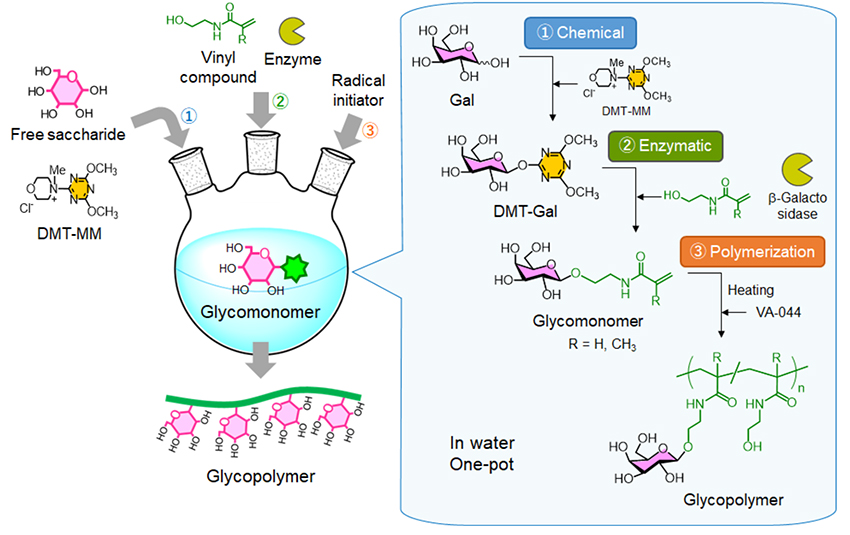
Direct or one-pot synthesis of glycomonomers from free saccharides is advantageous because it is straightforward and reduces environmental impact27,28. However, to the best of our knowledge, no studies have reported the one-pot synthesis of glycopolymers in water directly from free saccharides. We used 4,6-dimethoxy triazinyl glycosides (DMT-glycosides), which can be synthesized from unprotected sugars in a single step in water. These derivatives serve as effective donor substrates for enzymatic glycosylation catalyzed by glycosidases29-35. By combining chemical and enzymatic reactions in water to generate glycomonomers, followed by polymerization of the resulting monomers without isolation, we achieved the one-pot synthesis of glycopolymers in an aqueous medium directly from unprotected sugars (Figure 5)36,37. Specifically, unprotected galactose (Gal) was reacted with the water-soluble dehydrative condensation reagent, 4-(4,6-dimethoxy-1,3,5-triazin-2-yl)-4-methylmorpholinium chloride (DMT-MM), in water under basic conditions to produce the dimethoxytriazine derivative of galactose (DMT-Gal). Next, enzymatic glycosylation was conducted using β-galactosidase as the catalyst and 2-hydroxyethyl acrylamide as the acceptor substrate for DMT-Gal, affording a glycomonomer bearing a Gal moiety in an aqueous buffer. After thermal inactivation of the enzyme, the water-soluble radical initiator 2,2'-azobis[2-(2-imidazolin-2-yl)propane]dihydrochloride (VA-044) was added, and radical polymerization was performed in the aqueous medium to synthesize a glycopolymer with Gal side chains directly from the unprotected sugar. Similarly, glycopolymers were successfully obtained in a one-pot manner from unprotected sugars in aqueous media when 2-hydroxyethyl methacrylamide was used as the acceptor substrate in the enzymatic reaction or when unprotected lactose was used for DMT-glycoside synthesis, followed by enzymatic formation of the glycomonomer using cellulase. This chemoenzymatic synthesis of glycopolymers from free saccharides in water is unprecedented. Furthermore, chemoenzymatic methods that combine chemical synthesis with enzymatic reactions are widely used for the preparation of a variety of carbohydrate-based compounds38,39.
This review provides an overview of synthetic methods for glycopolymers and presents our studies on their synthesis in water. Although water is a suitable solvent for carbohydrate compounds, it has long been considered a limiting factor in chemical synthesis. This review describes methods that enable the stable and efficient synthesis of glycopolymers in water. These approaches include the design of water-soluble activated ester-bearing monomers and the use of chemoenzymatic strategies. These advances are valuable for building a sustainable society and promoting green chemistry. They are expected to help reduce environmental impacts while enabling the development of functional materials. Further advancement of aqueous synthetic methods and expansion of their applicability are anticipated to promote the discovery of new functional polymers, including glycopolymers, and to broaden their applications in biotechnology, medicine, and materials science. Finally, the author would like to thank all coworkers and laboratory members for their contributions to my research.