Isogai A, Zhou Y. Diverse nanocelluloses prepared from TEMPO-oxidized wood cellulose fibers: Nanonetworks, nanofibers, and nanocrystals. Cur. Opin. Solid State Mater. Sci. 2019; 7: 316(1-8).
Hou G, et al. Comprehensive study of preparation of carboxy group-containing cellulose fibers from dry-lap kraft pulps by catalytic oxidation with solid NaOCl. ACS Sustain. Chem. Eng. 2024; 11: 14782-14792.
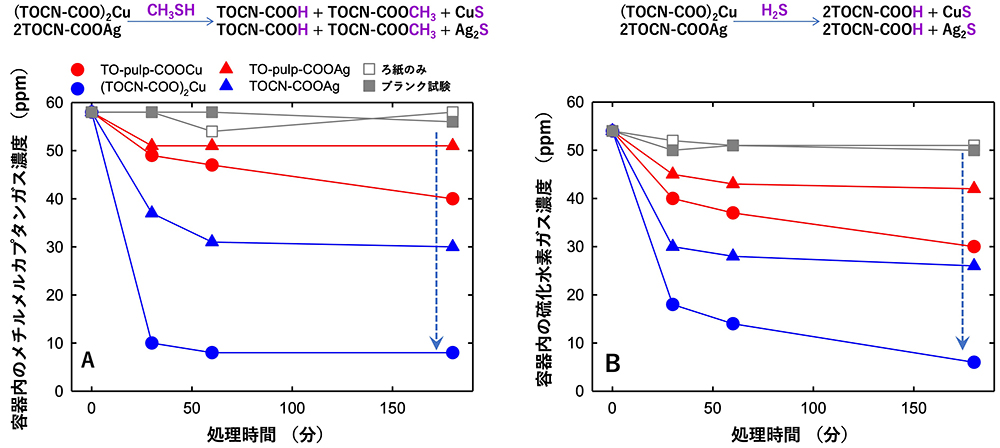
Sone A, Saito T, Isogai A. Preparation of aqueous dispersions of TEMPO-oxidized cellulose nanofibrils with various metal counterions and their super deodorant performances. ACS Macro Lett. 2016; 5: 1402-1405.
Sone A, Isogai A. Attachable/detachable sheets containing foam-rubber layers with super deodorant functions. Ind. Eng. Chem. Res. 2023; 62: 416-422.
Koga H, et al. Topochemical synthesis and catalysis of metal nanoparticles exposed on crystalline cellulose nanofibers. Chem. Commun (Camb). 2010; 46: 8567-8569.
Koga H, Kitaoka T, Isogai A. In situ modification of cellulose paper with amino groups for catalytic applications. J. Mater. Chem. 2011; 21: 9356-9361.
Azetsu A, et al. Synthesis and catalytic features of hybrid metal nanoparticles supported on cellulose nanofibers. Catalysts 2011; 1: 83-96.
Koga H, et al. Topological loading of Cu(I) catalysts onto crystalline cellulose nanofibers for the Huisgen click reaction. J. Mater. Chem. 2011; 22; 5538-5542.
Matsumoto M, Kitaoka T. Ultraselective gas separation by nanoporous metal organic frameworks embedded in gas‐barrier nanocellulose films. Adv. Mater. 2016; 28: 1765-1769.
Fukuzumi H, et al. Transparent and high gas barrier films of cellulose nanofibers prepared by TEMPO-mediated oxidation. Biomacromolecules 2009; 10: 162-165.
Fukuzumi H, et al. Selective permeation of hydrogen gas using cellulose nanofibril film. Biomacromolecules 2013; 14: 1705-1709.
Zhao M, et al. Nematic structuring of transparent and multi-functional nanocellulose papers. Nanoscale Horiz. 2018; 3: 28-34.
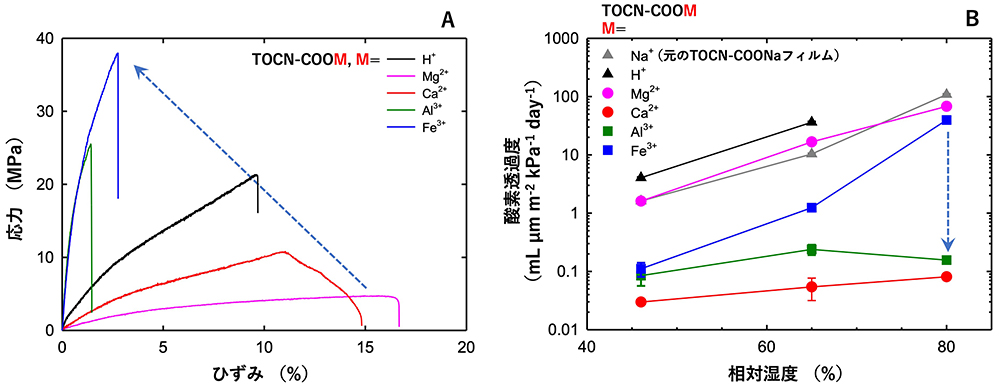
Shimizu M, Saito T, Isogai A. Water -resistant and high oxygen-barrier nanocellulose films with interfibrillar cross-linkages formed through multivalent metal ions. J. Membr. Sci. 2016; 500: 1-7.
Shimizu M, et al. Bulky quaternary alkylammonium counterions enhance the nanodispersibility of 2,2,6,6-tetramethylpiperidine-1-oxyl-oxidized cellulose in diverse solvents. Biomacromolecules 2014; 15: 1904-1909.
Shimizu M, Saito T, Isogai A. Hydrophobic, ductile, and transparent nanocellulose films with quaternary alkylammonium carboxylates on nanofibril surfaces. Biomacromolecules 2014; 15: 4320-4325.
Soeta H, et al. Lo w-birefringent and highly tough nanocellulose-reinforced cellulose triacetate. ACS Appl. Mater. Interfaces 2015; 7: 11041-11046.
Fujisawa S, Saito T, Isogai A. Nano-dispersion of TEMPO-oxidized cellulose/aliphatic amine salts in isopropyl alcohol. Cellulose 2012; 19: 459-466.
Fujisawa S, et al. Surface engineering of ultrafine cellulose nanofibrils towards polymer nanocomposite materials. Biomacromolecules 2013; 14: 1541-1546.
Fujisawa S, et al. Comparison of mechanical reinforcement effects of surface-modified cellulose nanofibrils and carbon nanotubes in PLLA composites. Compos. Sci. Technol. 2014; 90: 96-101.
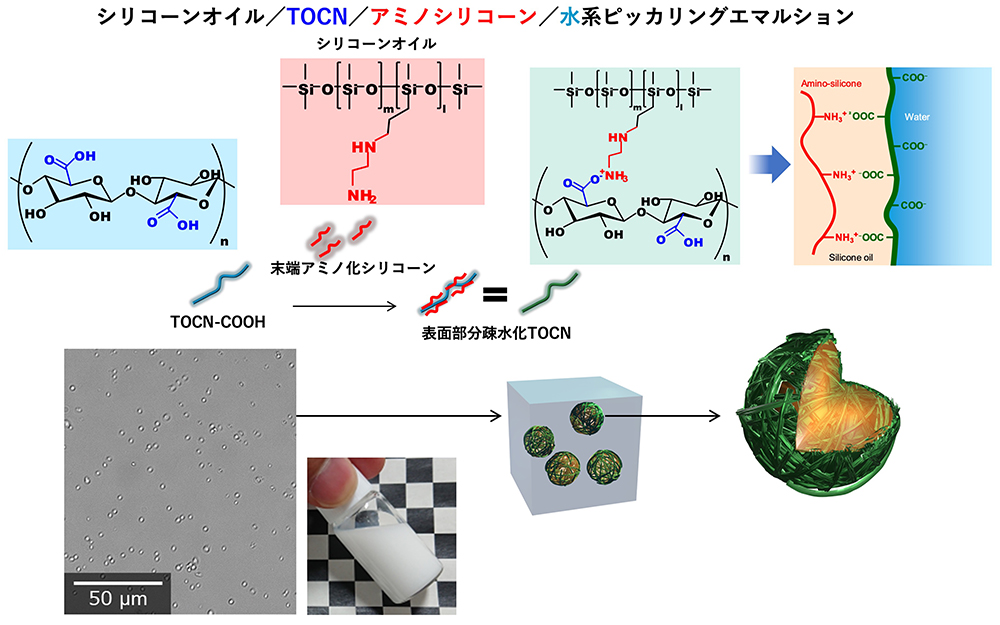
Takeuchi T, et al. Silicon oil/water Pickering emulsions with surface-hydrophobized cellulose nanofibers formed via in situ homogenization with amino-silicone. ACS Appl. Polym. Mater. 2024; 6: 8150-8158.
Yamato K, et al. Surface modification of TEMPO-oxidized cellulose nanofibers, and properties of their acrylate and epoxy resin composite films. Cellulose 2022; 29: 2839-2853.
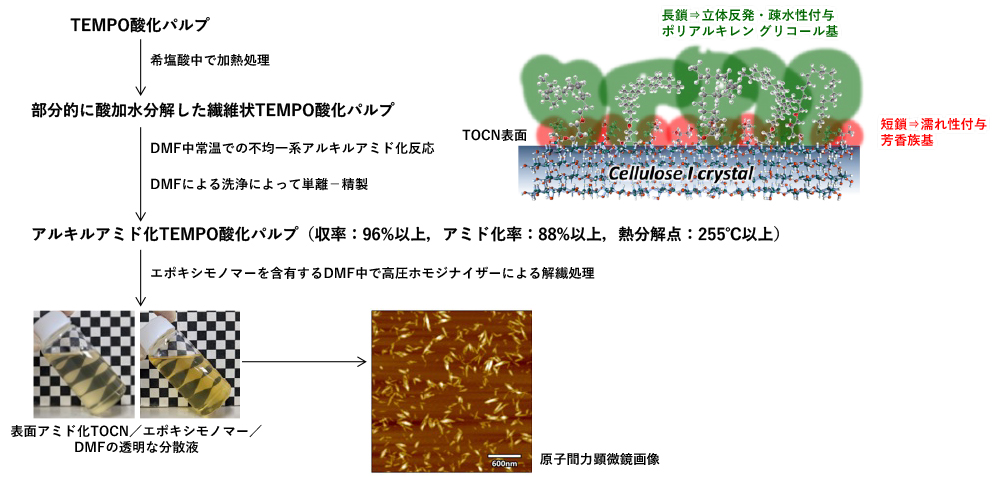
Yoshikawa Y, et al. Amidation of carboxy groups in TEMPO-oxidized cellulose for improving surface-hydrophobization and thermal stability of TEMPO-CNCs. Carbohydr. Polym. 2025; 347: 122645.
Isogai A. Structural characterization of modifications of surface-oxidized cellulose nanofiber. J. Jpn Petrol. Inst. 2015; 58: 365-375.
Noguchi T, et al. Cellulose nanofiber/elastomer composites with high tensile strength, modulus, toughness, and thermal stability prepared by high-shear kneading. Compos Sci. Technol. 2020; 188: 108005.
Noguchi T, et al. Cellulose nanofiber-reinforced rubber composites prepared by TEMPO-functionalization and elastic kneading. Compos. Sci. Technol. 2021; 210: 108815.
Noguchi T, et al. Cellulose-nanofiber-reinforced rubber composites with resorcinol resin prepared by elastic kneading. Macromol. Mater. Eng. 2021; 306: 2170046.
Jinnai H, et al. Real -time observation of microcrack growth in thin film microtomed from rubber/nanocellulose composite sheets, during tensile deformation. Polym. Compos. 2022; 43: 6310-6319.
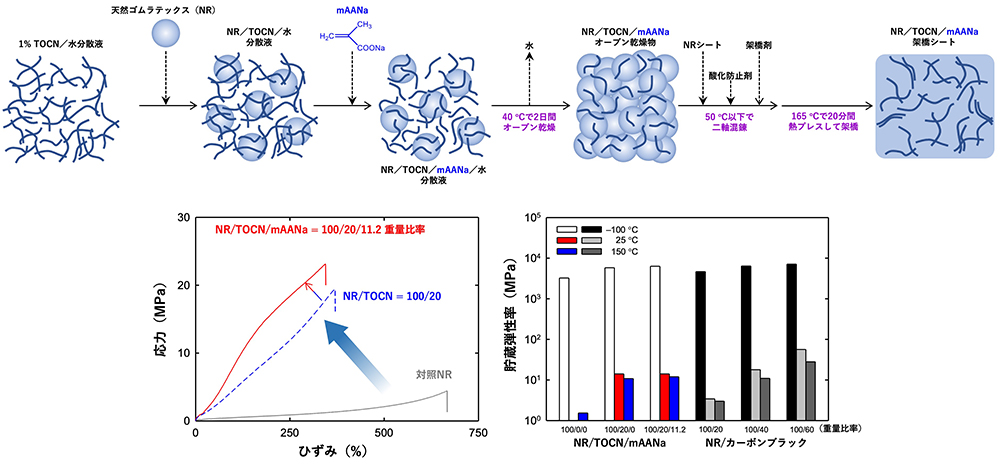
Noguchi T, et al. Natural rubber composites with high strength, modulus, water-resistance, and thermal stability, prepared with cellulose nanofibrils and sodium methacrylate. Compos. Part A Appl. Sci. Manuf. 2023; 173: 107665.
Noguchi T, et al. Improvement of water-resistance of natural rubber/nanocellulose composites. Polym. Degrad. Stab. 2024; 228: 110919.
Goi Y, et al. Dual functions of TEMPO-oxidized cellulose nanofibers in oil-in-water emulsions: a Pickering emulsifier and a unique dispersion stabilizer. Langmuir 2019; 35: 10920-10926.
Okahashi K, et al. Nanocellulose-containing cellulose ether composite films prepared from aqueous mixtures by casting and drying method. Cellulose 2021; 28: 6373-6387.
Chen H, et al. Preparation and characterization of nanocellulose-reinforced water-soluble cellulose acetate films. React. Funct. Polym. 2024; 205: 106083.
Li T, et al. Developing fibrillated cellulose as a sustainable technological material. Nature 2021; 590: 47-56.